I must have been very nervous as I passed the Immigration counter and entered the Customs area at the Hobby International Airport in Houston, carrying my suitcase towards the exit door. I showed the agent at the gate the properly filed form, expecting him to let me go without inspection, at which time the Customs agent asked me where I was coming from, “The Cayman Islands”, I answered, deep inside wishing I hadn’t said it. And hopping he would let me go through. Not so easy! The customs agent told me at that moment that I should go to hand inspection point, about 40 feet away, where a six foot tall, blond and tough faced Texan man wearing sun glasses was waiting for me. I must have been sweating and my heart must have been about to have a stroke, but I got to the inspection point and the agent, pretending I was calm. The agent ordered me to open my suitcase and stay three feet away of it. He went literally through every piece of cloth I had in the case, I mean every pant, every short, every shirt, every underwear I had in it, then he asked me if the wrapped package which up until then hadn’t been touched, was mine, I said “no, it belongs to a friend who is sending Christmas presents to his family”. It was like giving him an order to tear everything up. Inside the wrapped package there were about ten smaller packages wrapped up in Christmas paper, the customs’ agent torn them all up and inspected everything every little present in the package. I was mute, I must have been yellow pale and my heart was sounding like a drum and about to blow out of my chest. Finally, after about ten minutes of inspection, the customs agent told me to shut my bag and gave me the OK to go through the exit door. I have never felt so happy to be let go, those ten minutes of inspection felt like years of imprisonment.
Once out of the Customs area, I felt so happy I have no words to describe my state of mind at that moment, the fact of the matter is I was so relieved I could only think of hurrying up to take the airport tram which would take me to my connecting flight to Salt Lake City which I made it right on time. In my way to the gate I could only think of my family, and how happy I was going to feel when I could embrace them, kiss them and tell them I loved them so much. The events of this day made me realize how fragile our lives are, how fragile and subject to change our state of mind could be. In fact, our life is like a roller coaster where emotions can go so high and then go so much down, so fast, that anything can happen in just a short period of time. A few hours later, around 5PM Salt Lake City time, I was with my family, I had never wished to be with them so much, I felt I was in heaven. A couple of days later and after going Christmas shopping with my family I was ready to celebrate Jesus’ BD!. Merry Christmas to everyone!.
The day after I arrived in SLC; I called Buzz and Barbara Murphy and told them of my anguish, my doubts and my desperation while flying, and at the Hobby Airport’s US Customs area. First, I apologized to them for my doubts and then I told them their “reconstructed” package was on its way to its final destination through the US postal service. Both Buzz and Barbara laughed their hearts out, they didn’t feel offended at all, on the contrary, they said they felt ashamed and sad for not having warned me that such kind of thorough reviews are customary they were used to tem.
That was one of my most beautiful Christmases ever, it was a real White Christmas, the great Wasatch Front Mountains, right in front of our house were as white as they can be, they had never looked more beautiful to my eyes, I was the happiest man in the whole wide world. I felt happy to have a family, I felt happy to have a home where my wife and my children were all waiting for me, I never felt so happy to be home.
Life returned to normal a few days later, I had to go to Buenos Aires (“BA”) again; I did it through the NY Kennedy airport this time. In my way to BA, which literally took over 12 hours of flying time, I had sufficient time to think about my life and where was heading and taking my family with me. I wrote down a few ideas in my notebook. I remember I did it just like I was planning my year 1984. Among the points I wrote was one that read “Try to get a new job, one which would not include so much travelling”.
Once in Buenos Aires, my routine work started: Meetings with Alberto Angeleri about the Entre Lomas oil field; visiting Maria Ortelli (the manager of Petrolera Perez Companc) accompanied by Alberto, to find out what the plans for the new year included in terms of new investments, cash to the partners (if any), responses to some production, accounting and financial issues; etc. This time my trip included a visit the oil field in the Province of Neuquén in the Argentine Patagonia with Alberto Angeleri who was always a great friend of mine; check the books’ closing for the year 1984, etc. But, on the social agenda, Alberto’s team at APCO, especially the girls in the Accounting Department had prepared a special treat for me. As a new years present, they handed me a ticket for a concerto by the Berlin Philharmonic Orchestra, at the Teatro Colon in Buenos Aires. That was very nice of them, I felt very grateful for the present. I had a problem with that though, my problem was I had never, ever, been to one of this kind of performances, nor I had ever been exposed to this kind of events, and, apart from Mozart’s classical music which I had always loved, due to my humble origin, my education never included what you may call “musical education”, so, thankful as I was for such a nice present, deep inside myself, I felt that I might not be able to stand to the occasion.
I attended the Concerto; I had to dress up for the occasion with a suit and tie, of course, just like all other attendants did. I paid the most attention to the music, the stage looked magnificent, and the whole place looked like one of those Vienna theaters attended by “la crème de la crème” of the European royalty at the beginning of the 1900’s. I was sitting in the middle of the third row, at no more than 30 feet from the stage. The orchestra had world class musicians performing at their best, the violins sounded like music from heaven, however, I was just not up to the occasion, little Rafico, from Pallatanga never had a chance to learn music when he was a kid, neither he had the time to spend learning anything about it while he was a young man. The orchestra was playing just too classical a music for my ears to properly catch and my brain to process at the same time. I have always felt shy to say it, but I’m now confessing to all of you that by the middle of the show, I fell asleep... it was just too much of a sophisticated music for little me, for the young man who went to night school at the Borja Lavayen Secondary School in Guayaquil, to understand and enjoy such a jewel of world classic music. I was ashamed then, and I feel kind of shy to tell the story now, but that’s the truth, that happened, and I believe that by saying it to all of you now, I will feel better. In fact, I feel better already, because I believe most, if not all of you will understand me. Some of you might laugh at me, some of you might even think I should have never said it, but I know that most of you will agree with me that telling the truth should never be a reason to be ashamed.
In my next posting: RETURNING TO OUR HOME TOWN-GUAYAQUIL

A memoir written by a 67-year-old grandpa to tell his children and grand children about his roots, his childhood in a little village in the Ecuadorian mountains, his difficult but productive years as a teenager, his struggle to overcome the hardships of poverty through hard work and sacrifice, and his success as a corporate executive.
Monday, February 7, 2011

Saturday, January 29, 2011
TRAVELLING MORE THAN EVER BEFORE

BUENOS AIRES, THE ARGENTINE CAPITAL,
ONE OF THE JEWELS OF LATIN AMERICA
At first it was kind of nice, going places with all expenses paid, travelling first class and staying at five star hotels, I confess, was really fun when I was 40, but, when such travel means you have to leave your family behind more than two thirds of your time, I can tell you, it soon gets into your nerves! That was the case with me. Between my trips to Argentina and my visits to the Cayman Islands I was away from home more than it was humanly tolerable.

THE CAYMAN ISLANDS, A PARADISE
FOR SCUBA DIVERS
Even for a young guy like me, staying away from the family most of the time was not pleasant at all, to put it in a mild way. The whole weight of growing the kids, of caring for the three young ones in the family was falling on Fanny’s lap, it wasn’t fair to say the least, though, much to her admirable endurance and character, she never complained. True, when I was at home we tried to make up for my frequent and prolonged absences by going places, visiting friends, going fishing in the summer or skiing in winter time. My wife was very understanding of the whole situation, however, the kids started to complain more and more, especially the youngest one, two year old Angie, who sometimes didn’t even recognized me when I returned home after being away for three or more weeks. So, without saying anything to anybody, I began to think about looking for another job in the winter of 1983, however, I just send my first application for a job in July. It was for a position as an analyst in the World Bank, in Washington D.C. My application was never answered, nor did I make an effort a follow up on it, I was just testing ground. Behind my lack of real desire to leave was the fact that I was being paid an excellent salary at Northwest, a salary that was certainly well above the market for comparable positions, so it would have been hard to match it in any other job within my scope.

THE SEVEN MILE BEACH IN
GRAND CAYMAN, THE CAYMAN ISLANDS
Between trips to Buenos Aires and Grand Cayman, the months went by; the skiing season of 1982-83 was great, as there were over 70 inches of snow in the mountains in the Salt Lake City area for most of the winter. My family and I enjoyed that skiing season together most weekends and holidays. We found a family who cared for Angie on Saturdays and Sundays and off we went to the mountains. Mariuxi and Rafaelito (10 and 8) were good skiers by then, and participated in the company’s skiing club contests. They were very happy kids. Maria Paula Angeleri, who was spending the winter with our neighbors the Bemis, was always in the mountains with us, she loved skiing and therefore she was having the time of her life too. In fact, Maria Paula used to spend a great deal of her time with us, where she always felt at home.
Our Argentine operation was not changing very much from what had been for the previous ten years. Naviera Perez Companc, the majority partner in the Entre Lomas Oil field joint venture, was always doing things the way they thought was most beneficial to their own interest; with no regard whatsoever for the interest of their minority JV partner, APCO ARGENTINA. By then it was time to start what is called in the oil production industry a “secondary recovery project”, and, therefore, it was time to “reinvest” the profits generated by the Entre Lomas milking cow. Again, APCO Argentina was a almost a completely passive witness to the important events going on in the field. For us, it was like saying "hey, we are rich, very rich, but, unfortunately we can’t have our money, our partner says it has to be reinvested so we can become richer at a later time"
In the summer of 1983, we decided to take a vacation in Ecuador, so in early July, off we flew to Guayaquil. We were five in the family, our kids did not have a good memory of how Guayaquil was like, and we were all excited to go back to our country, to our home town and to see the relatives we hadn’t seen in several years. The weather however, played a bad trick on us. As we arrived in Guayaquil, the El Niño atmospheric phenomenon, which manifests itself with torrential rains and very hot temperatures, as well as hotter than normal sea waters, was blasting with no mercy the Ecuadorian Coastal Region where Guayaquil is located. It rained and rained, and rained, day and night, thundering and lightning were an intermittent part of our daily lives, it rained cats and dogs, there were mosquitoes and all other kinds of hot and humid weather insects every where, in sum, Guayaquil had become itself the nicest place to be away from, and so away we went. We changed our plans and decided on having our holidays in Quito and Buenos Aires, where we found a lot better weather to accompany us. Though we didn’t say it, we all felt that Guayaquil was not a nice place to spend our vacations any more, at least not our summer of 1983 holidays.
Spanish Cove our Caribbean scuba diving resort, also under my jurisdiction of controllership, was showing a negative bottom line, although not seriously negative, it was a reason to be concerned and to monitor it more frequently. Though we couldn’t say it was a seriously bleeding wound for the parent company, Northwest Pipeline, there were reasons to monitor it closer than in profitable times. Aware as we were, that this was our CEO’s favorite toy, we needed to make sure that things were running in an orderly and business like way, after all, he used to come by at least once a month, flying the company's plane and accompanied by his wife and other important business associates, so it was in the order of the day to make sure everything was marching very much to his satisfaction.

THE CAYMAN ISLANDS, GREAT
BEACHES AND SCUBA DIVING
As the year end holidays approached, on December 22, 1983, after completing my review of the books of Spanish Cove, in Georgetown, British West Indies, I was scheduled to go back to Salt Lake City via Houston. The night before my departure for the continent, I was approached by Buzz Murphy, the manager of the resort and Barbara Murphy, his wife, who asked me to take with me a pack of things they were sending to their family in the US. I said of course, I can do that for you and I took the sealed package weighing about five pounds and took it to my room where I placed it in my suitcase.

CAYMAN ISLANDS DIVING AT ITS BEST
The day after, in the morning, Buzz took me to the airport in Georgetown and off I started my flight to Houston. Once in the airplane, I handed a copy of the local newspaper and started to read it. At first there were no news that attracted my attention, but, all of a sudden, in the third page of the paper, I saw this large headline: “CAYMAN ISLANDS ARE A TRANSIT PORT FOR DRUGS GOING TO THE US". I immediately started to read the article where they reported that for some time, the US DEA had been capturing small cargoes of cocaine originating in Colombia, as they were in their way to be smuggled by people flying from the Cayman Islands to Houston, Miami and Atlanta.
Suddenly, I was scared to death!, what if the package that was given to me the night before and that was in my travelling bag was cocaine that Buzz and Barbara were sending to the continental US, using me as their mule?. I suddenly felt like vomiting, I was anguished to the point of desperation. For a moment I felt like talking to the one of the crew members to tell her my story and my fear, but then, I felt horrible for making such a terrible pre-judgment about people I thought i knew damn well. I thought I was making a serious mistake, after all, I had known Buzz and Barbara Murphy for over a year, and both of them were very nice, hard working people whose friendship and respect I had gained over time.
I had this very serious dilemma in my mind, it was almost like “I’m at a horrible risk, and my family is too, if the package I’m carrying in my suitcase is cocaine I’m dead meat, my family and I will pay the consequences of my stupidity, but if it’s not, I’m making a terrible judgment on two people I know and respect very much”. “What should I do?” I didn’t know which side to take, I had been thinking about which way to go and haven’t taken a decision until the crew announced we were approaching the Houston airport, at which time it was too late to try talking to any member of the crew, so I decided that I would stay put, I will just pray to God that everything was alright and that in fact the package contained Christmas presents for Buzz and Barbara’s family in the US. And praying I did.
In my next posting: WHAT DID THE PACKAGE CONTAIN?
Tuesday, January 18, 2011
BACK IN SALT LAKE CITY
It wasn’t a change in itself, on the contrary, it was a kind of “back to normal” situation where the kids got back to their school, we got back to our home, which we had rented for a year and was vacated a week before we returned. Everything was just like having been kept on a freezer for a year and suddenly returned to life. Our neighbors, our friends, my office, Fanny´s daily work was just as if it was only yesterday that we left and today we returned.

YELLOWSTONE NATIONAL PARK-
NATURE AT ITS BEST
By the beginning of June of 1983, we decided to go visit Yellowstone, the most beautiful National Park we have ever seen. This is the oldest National Park in the US and was established in 1872, Yellowstone extends its natural wonders to territories in three different states; Wyoming, Montana and Idaho.
 BUFFALOS PASTURING IN YELLOWSTONE
JUST LIKE IN THE MID 1800'S
The park is only hours away from Utah, and it is home to a large variety of wildlife including grizzly bears, wolves, bison, and elk.

OLD FAITHFUL THE MAIN
ATTRACTION IN YELLOWSTONE
Carefully preserved within Yellowstone National Park are Old Faithful and a collection of the world's most extraordinary geysers and hot springs and the Grand Canyon of the Yellowstone River, all of them true wonders of nature in which the US Parks Service has traditionally done a magnificent job at preserving the beauty of Mother Nature.

A BUFFALO AND HER CALF AT
YELLOWSTONE NATIONAL PARK
In our way back from Yellowstone, we stopped in Idaho and as we arrived to jackson Hole, we enjoyed a boat ride in the Snake River and watched an enormous variety of wild life on both sides of it. Angie (2 1/2 years old) endured the whole trip and seemed to enjoy not only mother nature at its best, but the company of her sister and brother as well as the pampering of her parents.

GRAND TETON NATIONAL
PARK, WYOMMING
Jackson Hole is a beautiful old town reminiscent of the old Wild West and here we took pictures of Angie and Rafaelito with the traditional raccoon tale hat used by hunters in the old west days. Not very far from Grand Teton National Park, which is located in the northwestern section of the state of Wyoming, we found spectacular views with immaculate mountains and clear bustling streams, all within the Grand Teton range of mountains peering up above it.

GRAND TETON IN THE FALL,
INCREDIBLE NATURAL BEAUTY
Grand Teton National Park was established on February 26, 1929 and covers almost 500 square miles of land and lakes water. There are nearly 200 miles of trails for hikers to enjoy in Grand Teton National Park, which attracted then over 2.5 million visitors a year, making the park and the Grand Teton Range one of the most visited sites in the United States
A few weeks later, for the 4th of July holiday, we headed south toward the Arches National Park, a great wonder of nature which preserves over 2,000 natural sandstone arches which include the world-famous Delicate Arch, as well as many other unusual rock formations.
 ARCHES NATIONAL
PARK, UTAH
In some areas, the forces of nature, mainly the winds, have masterly exposed millions of years of geologic history.
The extraordinary features of the park create a landscape of contrasting colors, landforms and textures that is unlike any other in the world.

CRAFTED OVER MILLIONS
OF YEARS AT ARCHES NP
 NO MAN'S HANDS
COULD HAVE
EVER DONE THIS
We spent two days at this park, staying within it for one night.

DELICATE ARCH AT ARCHES
NATIONAL PARK, UTAH
As we continued driving on the Interstate 15 highway, we visited Zion National Park, designated as such in 1919. Zion is Utah's oldest national park which is known for its incredible canyons, including spectacular “The Narrows”, which attract canyoneers from around the world. Hiking possibilities are endless, however, we couldn’t do any of it as we had little Angie with us, riding either her little stroller or my own back. With nearly two million visitors per year, Zion was then, as it is today, Utah’s most heavily visited park.
 THE THREE PATRIARCHS IN ZION
CAYON NATIONAL PARK, UTAH
A prominent feature of the park is Zion Canyon, 15 miles long and up to half a mile deep, cut through the reddish and tan-colored Navajo Sandstone by the North Fork of the Virgin River, a tributary of the Colorado River. The lowest and highest elevations are 1,200 and 8,726 ft respectively.

OTTOM A THE ENTRANCE TO
ZIONS NATIONAL PARK, UTAH
The park is Located at the junction of the Colorado Plataeu and the Mojave Desert regions. Its unique geography and variety of life zones allow for unusual plant and animal diversity. Numerous plant species as well as 289 species of birds, 75 mammals and 32 species of reptiles inhabit the park's four life zones. Its fauna include mountain lions, mule deer and Golden Eagles. Zion National Park includes mountains, canyons, buttes, mesas, monoliths, rivers and, of course natural arches.
In September, by the Labor Day holiday we again decided to travel far away in our very comfortable and efficient 1981 Honda Accord. This time we drove west on Interstate 80 toward the Pacific Coast. We drove about 500 miles in one day to Reno, Nevada where we stayed overnight at the Flamingo Hotel. It was in Reno that we had a bad time when we parked our car in front of a food store and found that it wasn’t there when we returned. Firtunately it hadn't been soled, it had just been tugged away for bad parking and I had to pay a $50 fine to have it returned.
Our next destination was San Francisco, however, the second night we slept in San Jose, since we wanted to visit Yosemite National Park, another wonder of Nature, which we did the following night. John Muir helped sparked the creation of Yosemite National Park, home to the gigantic sequoia trees, in 1890. The beauty of this park is almost unparalleled and inspired one of its admirers and guardians of the Yosemite Grant to say:
“I have seen persons of emotional temperament stand with tearful eyes, spellbound and dumb with awe, as they got their first view of the Valley from Inspiration Point, overwhelmed in the sudden presence of the unspeakable, stupendous grandeur.”
For tens of thousands of years, humans have changed, and have been changed by, this place called Yosemite. The Ahwahneechee Indians lived here for many generations, followed by the arrival of Europeans in the mid-1800s. The rugged terrain challenged many early travelers, with just a few—only 650 from the mid-1850s to mid-1860s—making the journey to Yosemite Valley by horseback or stagecoach. By 1907, construction of the Yosemite Valley Railroad from Merced to El Portal eased the journey, thereby, increasing visitation.

YOSEMITE AT MID OTTOM
History says that seven present-day tribes descend from the people who first called this area home. Europeans arrived in the mid-1800s, and provoked violent disruptions that displaced the native populations. Early white settlers arrived and hosted writers, artists, and photographers who spread the fame of "the Incomparable Valley" throughout the world.

MOTHER NATURE SHOWING OFF
AT YOSEMITE NATIONAL PARK
History books detail the Mariposa Battalion entering Yosemite Valley in 1851 to remove the Ahwahneechee. As Euro-American settlement occurred, people arrived on foot, on horseback and by rail to rustic hotels. Parts of the landscape were exploited, spurring conservationists to appeal for protections. President Abraham Lincoln signed an 1864 a bill granting Yosemite Valley and the Mariposa Grove to the State of California.

MAMMOTH SEQUOIAS AT YOSEMITE
NATIONAL PARK IN CALIFORNIA
When we finished visiting Yosemite, we left for San Francisco, that beautiful city which Frank Sinatra sang to in “I left my Heart in San Francisco”. We enjoyed the city, visited the Golden gate, we rode the trolley and visited the market place.. One day later we headed south toward Los Angeles and San Diego, but that is going to be the material for my next posting.
The summer of 1983 was the most educational and entertaining summer our family and I had while lived in the US. Our children learned to like and respect Mother Nature and we educated ourselves by visiting these wonderful places not many people around the world have the luck to visit.
We all in our family learned then, and we know now, that Mother Nature is very delicate, she needs to be cared for, she needs not to be abused, but we feel extremely frustrated to hear even now, some 30 years later, that some people continue to claim that climate changes are a fact of life we have to live with, that there is nothing we, as a human race can do to stop those changes. We feel extremely frustrated by the fact that there are countries, first world countries that are willing to do nothing to stop the damage. Eventually they’ll learn too, however, by then it may be too late, and our children and grand children may have to live in a devastated world.
Meanwhile, at work, I got more responsibilities. Northwest Pipeline, through one of its international subsidiaries, decided to invest in the tourism industry and bought a couple of diving resorts in the Golf of Mexico, in the Cayman Islands, half way from Cuba to Honduras. I suspect this investment was a good excuse for the CEO of the company to use the company´s plane to go diving, since that was one of his favorite sports. Any way, two diving resorts in the Caribbean needed to be kept under control, and I was the Comptroller of those operations, on top of being the comptroller of the Argentine oil operation. Between the two operations, my travelling got more frequent than ever.
In my next posting: TRAVELLING GETS MORE FREQUENT THAN EVER BEFORE

YELLOWSTONE NATIONAL PARK-
NATURE AT ITS BEST
By the beginning of June of 1983, we decided to go visit Yellowstone, the most beautiful National Park we have ever seen. This is the oldest National Park in the US and was established in 1872, Yellowstone extends its natural wonders to territories in three different states; Wyoming, Montana and Idaho.
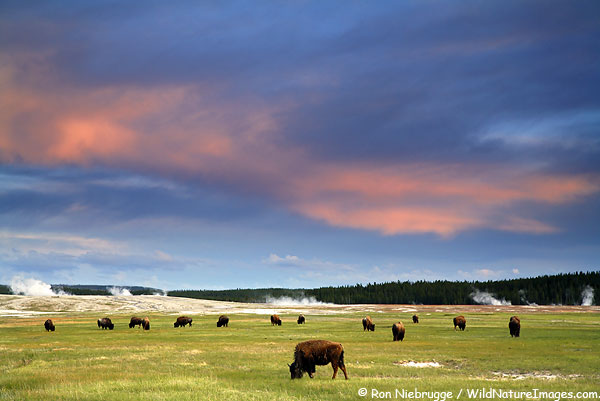 BUFFALOS PASTURING IN YELLOWSTONE
JUST LIKE IN THE MID 1800'S
The park is only hours away from Utah, and it is home to a large variety of wildlife including grizzly bears, wolves, bison, and elk.

OLD FAITHFUL THE MAIN
ATTRACTION IN YELLOWSTONE
Carefully preserved within Yellowstone National Park are Old Faithful and a collection of the world's most extraordinary geysers and hot springs and the Grand Canyon of the Yellowstone River, all of them true wonders of nature in which the US Parks Service has traditionally done a magnificent job at preserving the beauty of Mother Nature.

A BUFFALO AND HER CALF AT
YELLOWSTONE NATIONAL PARK
In our way back from Yellowstone, we stopped in Idaho and as we arrived to jackson Hole, we enjoyed a boat ride in the Snake River and watched an enormous variety of wild life on both sides of it. Angie (2 1/2 years old) endured the whole trip and seemed to enjoy not only mother nature at its best, but the company of her sister and brother as well as the pampering of her parents.

GRAND TETON NATIONAL
PARK, WYOMMING
Jackson Hole is a beautiful old town reminiscent of the old Wild West and here we took pictures of Angie and Rafaelito with the traditional raccoon tale hat used by hunters in the old west days. Not very far from Grand Teton National Park, which is located in the northwestern section of the state of Wyoming, we found spectacular views with immaculate mountains and clear bustling streams, all within the Grand Teton range of mountains peering up above it.

GRAND TETON IN THE FALL,
INCREDIBLE NATURAL BEAUTY
Grand Teton National Park was established on February 26, 1929 and covers almost 500 square miles of land and lakes water. There are nearly 200 miles of trails for hikers to enjoy in Grand Teton National Park, which attracted then over 2.5 million visitors a year, making the park and the Grand Teton Range one of the most visited sites in the United States
A few weeks later, for the 4th of July holiday, we headed south toward the Arches National Park, a great wonder of nature which preserves over 2,000 natural sandstone arches which include the world-famous Delicate Arch, as well as many other unusual rock formations.
 ARCHES NATIONAL
 PARK, UTAH
In some areas, the forces of nature, mainly the winds, have masterly exposed millions of years of geologic history.
The extraordinary features of the park create a landscape of contrasting colors, landforms and textures that is unlike any other in the world.

CRAFTED OVER MILLIONS
OF YEARS AT ARCHES NP
 NO MAN'S HANDS
 COULD HAVE
EVER DONE THIS
We spent two days at this park, staying within it for one night.

DELICATE ARCH AT ARCHES
NATIONAL PARK, UTAH
As we continued driving on the Interstate 15 highway, we visited Zion National Park, designated as such in 1919. Zion is Utah's oldest national park which is known for its incredible canyons, including spectacular “The Narrows”, which attract canyoneers from around the world. Hiking possibilities are endless, however, we couldn’t do any of it as we had little Angie with us, riding either her little stroller or my own back. With nearly two million visitors per year, Zion was then, as it is today, Utah’s most heavily visited park.
 THE THREE PATRIARCHS IN ZION
 CAYON NATIONAL PARK, UTAH
A prominent feature of the park is Zion Canyon, 15 miles long and up to half a mile deep, cut through the reddish and tan-colored Navajo Sandstone by the North Fork of the Virgin River, a tributary of the Colorado River. The lowest and highest elevations are 1,200 and 8,726 ft respectively.

OTTOM A THE ENTRANCE TO
ZIONS NATIONAL PARK, UTAH
The park is Located at the junction of the Colorado Plataeu and the Mojave Desert regions. Its unique geography and variety of life zones allow for unusual plant and animal diversity. Numerous plant species as well as 289 species of birds, 75 mammals and 32 species of reptiles inhabit the park's four life zones. Its fauna include mountain lions, mule deer and Golden Eagles. Zion National Park includes mountains, canyons, buttes, mesas, monoliths, rivers and, of course natural arches.
In September, by the Labor Day holiday we again decided to travel far away in our very comfortable and efficient 1981 Honda Accord. This time we drove west on Interstate 80 toward the Pacific Coast. We drove about 500 miles in one day to Reno, Nevada where we stayed overnight at the Flamingo Hotel. It was in Reno that we had a bad time when we parked our car in front of a food store and found that it wasn’t there when we returned. Firtunately it hadn't been soled, it had just been tugged away for bad parking and I had to pay a $50 fine to have it returned.
Our next destination was San Francisco, however, the second night we slept in San Jose, since we wanted to visit Yosemite National Park, another wonder of Nature, which we did the following night. John Muir helped sparked the creation of Yosemite National Park, home to the gigantic sequoia trees, in 1890. The beauty of this park is almost unparalleled and inspired one of its admirers and guardians of the Yosemite Grant to say:
“I have seen persons of emotional temperament stand with tearful eyes, spellbound and dumb with awe, as they got their first view of the Valley from Inspiration Point, overwhelmed in the sudden presence of the unspeakable, stupendous grandeur.”
For tens of thousands of years, humans have changed, and have been changed by, this place called Yosemite. The Ahwahneechee Indians lived here for many generations, followed by the arrival of Europeans in the mid-1800s. The rugged terrain challenged many early travelers, with just a few—only 650 from the mid-1850s to mid-1860s—making the journey to Yosemite Valley by horseback or stagecoach. By 1907, construction of the Yosemite Valley Railroad from Merced to El Portal eased the journey, thereby, increasing visitation.

YOSEMITE AT MID OTTOM
History says that seven present-day tribes descend from the people who first called this area home. Europeans arrived in the mid-1800s, and provoked violent disruptions that displaced the native populations. Early white settlers arrived and hosted writers, artists, and photographers who spread the fame of "the Incomparable Valley" throughout the world.

MOTHER NATURE SHOWING OFF
AT YOSEMITE NATIONAL PARK
History books detail the Mariposa Battalion entering Yosemite Valley in 1851 to remove the Ahwahneechee. As Euro-American settlement occurred, people arrived on foot, on horseback and by rail to rustic hotels. Parts of the landscape were exploited, spurring conservationists to appeal for protections. President Abraham Lincoln signed an 1864 a bill granting Yosemite Valley and the Mariposa Grove to the State of California.

MAMMOTH SEQUOIAS AT YOSEMITE
NATIONAL PARK IN CALIFORNIA
When we finished visiting Yosemite, we left for San Francisco, that beautiful city which Frank Sinatra sang to in “I left my Heart in San Francisco”. We enjoyed the city, visited the Golden gate, we rode the trolley and visited the market place.. One day later we headed south toward Los Angeles and San Diego, but that is going to be the material for my next posting.
The summer of 1983 was the most educational and entertaining summer our family and I had while lived in the US. Our children learned to like and respect Mother Nature and we educated ourselves by visiting these wonderful places not many people around the world have the luck to visit.
We all in our family learned then, and we know now, that Mother Nature is very delicate, she needs to be cared for, she needs not to be abused, but we feel extremely frustrated to hear even now, some 30 years later, that some people continue to claim that climate changes are a fact of life we have to live with, that there is nothing we, as a human race can do to stop those changes. We feel extremely frustrated by the fact that there are countries, first world countries that are willing to do nothing to stop the damage. Eventually they’ll learn too, however, by then it may be too late, and our children and grand children may have to live in a devastated world.
Meanwhile, at work, I got more responsibilities. Northwest Pipeline, through one of its international subsidiaries, decided to invest in the tourism industry and bought a couple of diving resorts in the Golf of Mexico, in the Cayman Islands, half way from Cuba to Honduras. I suspect this investment was a good excuse for the CEO of the company to use the company´s plane to go diving, since that was one of his favorite sports. Any way, two diving resorts in the Caribbean needed to be kept under control, and I was the Comptroller of those operations, on top of being the comptroller of the Argentine oil operation. Between the two operations, my travelling got more frequent than ever.
In my next posting: TRAVELLING GETS MORE FREQUENT THAN EVER BEFORE
Monday, January 10, 2011
HOUSTON IS OUR NEW HOME TOWN
Glenn pushed for a decision in that direction, and relatively soon he got the home office approval for his request. As a result, by mid April 1981, I began commuting between Salt Lake City and Houston every week, flying out to Houston very early on Mondays and returning to SLC late on Fridays. The Hyatt hotel in downtown Houston, which was only three blocks away from our office on Lamar Street, became my home for nine months, and the Restaurant Benihana of Tokyo became my dinner place every night. Dining at Benihana in a table for eight people made my daily solitude more bearable. That was the time when I became a fan of Japanese food, which I still love.
Working in Houston resolved one problem but created another. I was given high responsibilities in Houston and I felt that I was indeed earning my salary and making a good contribution to our company, but, I was away from my family seventy percent of the time, therefore they missed me and I missed them too. Working for APCO required that I travel to Argentina at least once every two months for a couple of weeks. Usually I would fly to NYC to make a connection to Buenos Aires, a flight that would take between 10 and eleven hours, but was not too tiring because, number one we were flying within the same time zone, and, I was always flying first class, a luxury that was allowed in all company business flights with a duration of four or more hours.
Those were the days when I began loving Buenos Aires in particular, but, Argentina in general, its people, and its food but I never got used to the tremendous fluctuations of Argentine prices and exchange rates. In one trip the cost of one night’s stay at the Claridge Hotel, one of the most traditional hotels in Buenos Aires was about $70, and the next trip it was $250, all because of the never ending escalation of prices and exchange rates. Between the bimonthly trips to Buenos Aires and the weekly trips from SLC to Houston, the rest of the year 1981 went by. In April 1982, I discussed the matter with Glenn and he requested and obtained approval from the upper management in SLC to have me and my family moved to Houston, which we did in June 1982.
Moving to Houston with the whole family we did in May of 1982. At first, we rented a house in a very nice golf area in NW Houston, about ten minutes away from Interstate Hwy 10, better known in Houston as the Dixie Highway. We lived in the Heartstone subdivision, 45 minutes away from my office in downtown Houston.
Houston was in those days something like the world’s capital of the oil industry, almost everything there was somehow connected to the ever expanding oil industry. It was the home town for the most important players in the world’s oil such as Mobil, Pennzoil, Royal Dutch, Shell, Texaco, British Petroleum, Conoco, Halliburton and the likes. In fact, it was home to the oil barons of those days.
Our company, Northwest Pipeline Corp, in spite of being a large company in the US Stock Exchange, was small in comparison to all those giants in the oil industry, in fact it had no significant oil fields in the continental US and 95% of its revenues were generated by its gas production and transportation geographically located in the Northwestern United States. APCO Argentina, its small subsidiary, domiciled in Houston, the company I was now assigned to as a Controller, derived all it revenues from the Entre Lomas oil field, located in Neuquén, in Southern Argentina, where we were a minority shareholder of Petrolera Perez Companc, the concessionary of the field, which was operated by our associate Naviera Perez Companc (“Naviera”). The company’s revenues deriving from the oil field, however, were very seldom materialized in cash, since the operator and majority shareholder of the oil company was always “reinvesting” in the field.
My job as a controller of the company in Houston was to make sure we kept a good eye on what our Associate Naviera was doing in terms of “reinvestments” in the oil field, since all works in connection with those reinvestments were carried on by Naviera our majority shareholder. I saw it from the beginning that it was a no winning situation, because the contract did not allow the minority shareholder (APCO) a veto power on the “reinvesting decisions of the majority shareholder. As a consequence, in the end, my job was to try to report, as accurately as possible, how much we were being screwed by our Argentine associates in Naviera.
Neither the continuous and clear technical reports from our people in Buenos Aires headed by Alberto Angeleri, who was always waiving red flags to Houston, nor the continuous visits to Buenos Aires by Glenn Nelle who was meeting with the top shots of Naviera , improved the cash flows for APCO Argentina. Somehow, The Northwest people had decided that in the end, patience will pay its dividends. No significant dividends were reported to the company for my entire tenure as a controller of the company which ended in May of 1984.
Meanwhile, our life in Houston was different in many ways to our life in Salt Lake City. To begin with, we were now living in a much larger city, a city of two and a half million people, as opposed to only half of a million people in SLC. People in our neighborhood in Houston were not nearly as friendly as they were in SLC., each family seemed to live their own lives, minding their own business and letting every body else mind their business. Our older kids were registered in the nearest public school, in a school district that was well known to be very good for the State standards, so that was OK, in fact neither Mariuxi, nor Rafaelito felt any significant negative or positive impact from the change.
In the absence of friends in our neighborhood, we looked and soon found some friends elsewhere in the area or through a networking that we began to apply when we started to feel the isolating effects of the lack of friends in the area where we lived. First it was some dear and old Ecuadorian friends living not very far away, and then the net started to work. Soon we began to feel as a part of a social group it was nice to be associated with, then the group made us feel as an important part of it. Our children found some friends of their age to play with, some of them attending the same school they attended. Felipe Rodriguez, a former classmate at the U of Guayaquil and a man who loved Houston more than any other place in the world (he called it “paradise”) was the first friend we found, and through him we found many other friends, including the Ecuadorian Consul, Mrs. Huerta who was the one who introduced us to many other Ecuadorian people who had been living in Houston for many years and loved it.
In spite of all the friends we found, and the fact that my wife Fanny felt much better in Houston than in SLC, I did not find very amusing the fact that I had to mow the lawn in my 2000 sq ft backyard, twice a week under 100 degree temperatures in the Houston Summer time, where I could almost watch the grass growing in the hot and rainy summers of the “oil capital of the world”. It was like being inside a sauna box. I did not enjoy this at all, so, when a year later my bosses in Salt Lake City announced that I had to go back to live in Salt Lake City, because the APCO Argentina offices were being moved to Utah, I was so much relieved and happy, I felt almost like getting out of hell. Our children loved it too. Fanny was less enthused but finally she was very happy to go back to our loved Utah too.
In my next posting: BACK IN SALT LAKE CITY
Working in Houston resolved one problem but created another. I was given high responsibilities in Houston and I felt that I was indeed earning my salary and making a good contribution to our company, but, I was away from my family seventy percent of the time, therefore they missed me and I missed them too. Working for APCO required that I travel to Argentina at least once every two months for a couple of weeks. Usually I would fly to NYC to make a connection to Buenos Aires, a flight that would take between 10 and eleven hours, but was not too tiring because, number one we were flying within the same time zone, and, I was always flying first class, a luxury that was allowed in all company business flights with a duration of four or more hours.
Those were the days when I began loving Buenos Aires in particular, but, Argentina in general, its people, and its food but I never got used to the tremendous fluctuations of Argentine prices and exchange rates. In one trip the cost of one night’s stay at the Claridge Hotel, one of the most traditional hotels in Buenos Aires was about $70, and the next trip it was $250, all because of the never ending escalation of prices and exchange rates. Between the bimonthly trips to Buenos Aires and the weekly trips from SLC to Houston, the rest of the year 1981 went by. In April 1982, I discussed the matter with Glenn and he requested and obtained approval from the upper management in SLC to have me and my family moved to Houston, which we did in June 1982.
Moving to Houston with the whole family we did in May of 1982. At first, we rented a house in a very nice golf area in NW Houston, about ten minutes away from Interstate Hwy 10, better known in Houston as the Dixie Highway. We lived in the Heartstone subdivision, 45 minutes away from my office in downtown Houston.
Houston was in those days something like the world’s capital of the oil industry, almost everything there was somehow connected to the ever expanding oil industry. It was the home town for the most important players in the world’s oil such as Mobil, Pennzoil, Royal Dutch, Shell, Texaco, British Petroleum, Conoco, Halliburton and the likes. In fact, it was home to the oil barons of those days.
Our company, Northwest Pipeline Corp, in spite of being a large company in the US Stock Exchange, was small in comparison to all those giants in the oil industry, in fact it had no significant oil fields in the continental US and 95% of its revenues were generated by its gas production and transportation geographically located in the Northwestern United States. APCO Argentina, its small subsidiary, domiciled in Houston, the company I was now assigned to as a Controller, derived all it revenues from the Entre Lomas oil field, located in Neuquén, in Southern Argentina, where we were a minority shareholder of Petrolera Perez Companc, the concessionary of the field, which was operated by our associate Naviera Perez Companc (“Naviera”). The company’s revenues deriving from the oil field, however, were very seldom materialized in cash, since the operator and majority shareholder of the oil company was always “reinvesting” in the field.
My job as a controller of the company in Houston was to make sure we kept a good eye on what our Associate Naviera was doing in terms of “reinvestments” in the oil field, since all works in connection with those reinvestments were carried on by Naviera our majority shareholder. I saw it from the beginning that it was a no winning situation, because the contract did not allow the minority shareholder (APCO) a veto power on the “reinvesting decisions of the majority shareholder. As a consequence, in the end, my job was to try to report, as accurately as possible, how much we were being screwed by our Argentine associates in Naviera.
Neither the continuous and clear technical reports from our people in Buenos Aires headed by Alberto Angeleri, who was always waiving red flags to Houston, nor the continuous visits to Buenos Aires by Glenn Nelle who was meeting with the top shots of Naviera , improved the cash flows for APCO Argentina. Somehow, The Northwest people had decided that in the end, patience will pay its dividends. No significant dividends were reported to the company for my entire tenure as a controller of the company which ended in May of 1984.
Meanwhile, our life in Houston was different in many ways to our life in Salt Lake City. To begin with, we were now living in a much larger city, a city of two and a half million people, as opposed to only half of a million people in SLC. People in our neighborhood in Houston were not nearly as friendly as they were in SLC., each family seemed to live their own lives, minding their own business and letting every body else mind their business. Our older kids were registered in the nearest public school, in a school district that was well known to be very good for the State standards, so that was OK, in fact neither Mariuxi, nor Rafaelito felt any significant negative or positive impact from the change.
In the absence of friends in our neighborhood, we looked and soon found some friends elsewhere in the area or through a networking that we began to apply when we started to feel the isolating effects of the lack of friends in the area where we lived. First it was some dear and old Ecuadorian friends living not very far away, and then the net started to work. Soon we began to feel as a part of a social group it was nice to be associated with, then the group made us feel as an important part of it. Our children found some friends of their age to play with, some of them attending the same school they attended. Felipe Rodriguez, a former classmate at the U of Guayaquil and a man who loved Houston more than any other place in the world (he called it “paradise”) was the first friend we found, and through him we found many other friends, including the Ecuadorian Consul, Mrs. Huerta who was the one who introduced us to many other Ecuadorian people who had been living in Houston for many years and loved it.
In spite of all the friends we found, and the fact that my wife Fanny felt much better in Houston than in SLC, I did not find very amusing the fact that I had to mow the lawn in my 2000 sq ft backyard, twice a week under 100 degree temperatures in the Houston Summer time, where I could almost watch the grass growing in the hot and rainy summers of the “oil capital of the world”. It was like being inside a sauna box. I did not enjoy this at all, so, when a year later my bosses in Salt Lake City announced that I had to go back to live in Salt Lake City, because the APCO Argentina offices were being moved to Utah, I was so much relieved and happy, I felt almost like getting out of hell. Our children loved it too. Fanny was less enthused but finally she was very happy to go back to our loved Utah too.
In my next posting: BACK IN SALT LAKE CITY
Saturday, December 25, 2010
OUR LIFE IN SALT LAKE CITY

THE STREET WHERE WE LIVED
IN SALT LAKE CITY IN 1980
Our social life, which I have said before was a very active one in Quito, during the first few months of our stay was almost non existent in Salt Lake City. That made us a bit home sick, but, slowly and consistently we began to develop a relationship with a few friends in our neighborhood, among whom our dearest ones were Wilmer (a former LDS bishop) and Nelly Barnett, our next door neighbors, whose children had already gone from home (Wilmer is the Angel who saved me from the effects of the first snow storm in early October 1980); Dennis & Marilyn Adams and their three lovely children; Murry and Nancy Bemis and their three children (the only non LDS couple in the neighborhood besides us); Ken and Roma Clark, whom I got to see last January and have kept themselves in very good shape); Piero Ruffinengo and Tony Durando (engineers and lawyers, Italian and were about my age), both of whom worked for Northwest Pipeline also, and were married to Jennifer ( a medical doctor) and Nann (a lawyer) respectively. Piero and Tony had just started to grow their own families and had young children too; Joe Vallely, who at the time was Northwest’s HR VP, and his lovely wife Ceres (from Puerto Rico) who later on became Angie’s God Mother, were also a very important part of our small social circle. Ceres Vallely, and her lovely mother Angela, became one of our closest friends and later on she became Angie’s baptism’s God Mother. We also met and became very good friends with Oscar and Mina Abeyta, the finest people from Mexico which we have ever met. We have kept in touch with them throughout these many years until these days. They have a daughter who married and came to live in Tampa, FL, not very far from Orlando, where we live one half of the year.

THE ADAMS' HOUSE IN FONTAINEBLEU DR.
IN SLC AS SEEN IN JANUARY 2010
Most of our neighbors were very friendly and helpful to us, but, Dennis and Marilyn Adams and their children need to be mentioned especially. Marilyn, who passed away only a year and a half ago, was the sweetest lady one can think of. In spite of the fact she had been suffering from a serious illness for a long time, no one in my family can remember one single time when she was not in a good mood, smiling and trying to be helpful. At two years of age, our youngest daughter, Angie became very independent and would walk away from home to go visiting either Mrs. Barnett, who became her main candy supplier, or Marilyn for other sweets. One of those days, Marilyn found Angie happily sharing lunch with their little dog, eating from the dog’s plate. Over the last 28 years, this story has remained and will continue to be one of the favorite subjects of our conversations with the Adams’, every time we get together, provoking our uncontained laughter. In January of 2010, I visited Dennis and had dinner with him and his family, at their always warm and welcoming home, in Fontainebleau Dr where he lives by himself. Dennis continues to be a happy looking man. He is a great cook, and once he fixed the best hash browns I have ever had in my whole life.

THE CLARKS AT THEIR HOME IN SLC IN JANUARY 2010
The Bemis also became our dear friends. We helped them make personal arrangements with our dearest friends the Angeleris in their Buenos Aires, Argentina, to have Gail, their 16 year old daughter go to Buenos Aires and spend a summer with them. Gail, a beautiful and very charming girl, had a great time in Argentina and the two families became great friends thereafter. I suspect that it was Gail’s fascination with the Spanish Language one of the reasons that made her fall in love, and then get married to a Spanish speaking young man from Mexico, with whom they now have three beautiful children. I saw them in Salt Lake City in January 2010, when I went there skiing and took some time to visit our Utah friends. Nancy Bemis also lives by herself, after her husband passed away many years ago. She lives right next door to the Adams. It was Nancy who, in our early days in SLC, was trying to help Fanny learn English by speaking so slow it got to be kind of funny.

NANCY BEMUS AT HER HOME IN SLC IN JANUARY 2010
She used to greet Fanny like this: Gooood moooorning Faaanny, hooooow aaaare youuu?, caaan Iiiiii beee oooof heeeelp thiiiis mooorniiing?, and she continued to talk like that to Fanny for a long time after she made sure Fanny was on track with her English. That just tells the helping attitude all our friends had with us while we lived in SLC.
Over time, Tony and Nann Durando became our dearest friends, and have remained so all of these many years after we left Salt Lake City and the U.S. Tony and I talk two or three times a year and when we do, we do it for an hour or more till our ears hurt. We have many things in common, mainly a most old fashioned concept of what a family should be, and we are very proud of our families and love and care for all and every one of their members. We have recently become grand parents and we are deeply in love with our grand children too.

VISITING THE DURANDOS IN SLC IN 1981
During our stay in Salt Lake City, the Durandos and our family began to visit one another with certain frequency, as a result, we were able to develop a closer relationship, which we have maintained and improved over time. Their oldest daughter Chiara came to visit us and stayed with us in Guayaquil during the summer of 1992; Fanny and I saw them again in mid 1997, in Tucson, AZ, where they have lived since the late 80’s, and we saw them again in Phoenix, AZ, at the end of April of 2000, when Mariuxi, our oldest daughter graduated from Thunderbird, The American International School of Business as a Master of International Business. Tony and Nann drove the 500 miles from Tucson, to be with us during that great day for our family. Tony and I maintain a fluid correspondence via internet and among other things, I have promised Tony that I will learn Italian (which I’m doing so), and he has promised me to improve his already fluent Spanish.
On the work front, at Northwest Pipeline, during my first few weeks at the home office, nobody knew what my responsibilities were going to be; later on and for a few months, I was assigned meaningless responsibilities, it was like they brought me in without a clear plan, no one was in charge of me, and no one would care about the cost of having me there. I began to wonder whether I made the right decision when accepting to move to Salt Lake City without a clear definition of what my new job was going to be. I understood later that in a big corporation like Northwest Pipeline, the decision making process was slow, sometimes very slow and some other times extremely slow. I was drawing a very good salary but I was not producing anything in return, and that made me feel concerned and somehow guilty. I had to be patient, but at the same time I was beginning to feel a bit nervous about the whole thing. It wasn’t until March of 1981, that my former boss Glenn Nelle, in Houston, at my request, took the initiative and suggested my presence in his office beginning mid April. He wanted me to be in charge of the controllership of APCO Argentina, the Northwest’s affiliate located in Houston, TX.
In my next posting: HOUSTON IS OUR NEW HOME TOWN
Thursday, December 16, 2010
A NEW MEMBER OF THE FAMILY ARRIVES

NEWBORN ANGIE IN HER SISTER'S ARMS
IN SLC, UT, OCTOBER 1980
Prepared we were. Fanny´s mom, who then lived in NYC, came over to help me with the kids. She was then 50, and was full of energy and willingness to help. I just don´t know how would I have faced the facts without her. On October 30, 1980, one day before Halloween, at 8:00 O´clock, our new baby, our youngest daughter was born, at the LDS Hospital up in "the avenues" near down town Salt Lake City. The place was adorned all over for the occasion, with lighted orange pumpkins and spooky witches flying on brooms. She was the only black haired child in the whole room. She was the subject of attention from almost everyone entering the newborns´ room, where there were at least another ten children, all of them blue eyed blondes, who had been born that same day.

THE DAY ANGIE WAS BORN, THE LDS HOSPITAL
IN SLC WAS DRESSED UP FOR HALLOWEEN
Since our new baby´s older sister and brother had been delivered through a C section, it was just to be expected that this baby would be delivered through the same procedure, therefore, I had requested the doctor to allow me to be present during the operation, which I did. I was asked to dress up just as the doctors do, with a long-green attire with a head cover and a mask, just as the doctor's assistants did. I was in the operating room during the whole procedure, separated from the operating team just by a light blue curtain with a small "window” which allowed me to see almost everything that was going on in there. The anesthesia Fanny got allowed her to be alert during the whole operation, therefore, she was looking at me and I was looking at her all the time providing her with an "eye support" she seem to need. Everything seemed to be going as desired.
In a matter of minutes, the doctor was holding my new baby up by her feet in his right hand. He said in a relatively high voice, “it’s a girl”, and suddenly slapped the baby´s butt so she could cry, but she didn´t cry…she screamed, making us know she was alive and very well.
Deep in my mind I had been hoping that it would be a baby boy, however, almost instantaneously I felt a great feeling of happiness. She was held up in the doctor`s hands for a while, her body was all covered by a whitish greasy looking substance which they soon had to clean the baby from. Fanny was awake and smiling at the baby and, in a matter of minutes, the medical team placed the baby in her mother's hands and soon the baby was feeding herself like an expert. Mother and baby smiled out of happiness and comfort. I kissed my wife and my new and beautiful baby and thanked Fanny for the wonderful gift she just delivered to our family.
Fanny and I had agreed about the bay’s names beforehand, so we started calling her Angie as soon as she was born. Her name is Angela for many reasons, not the least of them because she was, she is and she’ll always be an Angel to us, but she carries her mom’s middle name, which is also that of my only aunt’s, my father’s sister first name. My aunt died of cancer of the uterus when I was very young, and I have a very lovely memory of her and her caring character. She used to say I was her favorite nephew. My Angie’s middle name is Judith, for my mother’s middle name. Time has shown us that Angie carries in her character the vision, the sweetness, the firmness of character, the readiness for hard work and the determination of my mother as well.
Back in September, when we took our two young children (6 and 4) to Woodstock Elementary, Mariuxi (6), who at the time spoke no English, was accepted for kindergarten and was given a special tutor to help her with the language. We were told that she could be moved to first grade but she would need to understand and speak English by Christmas; otherwise she would remain in kindergarten for the entire year. Mariuxi not only passed the test of English, but she did it two months before it was due. The speed at which she learned the new language was astonishing and the School Principal personally congratulated us on her progress. Rafaelito was registered in pre-kinder and, at the beginning he had some minor difficulties learning the language and adapting to the new surroundings, but, by Christmas time he was already communicating mostly in English with his big sister and feeling comfortable with his peers.
Fanny and I had decided that in order to help in the preservation of our culture and our heritage, we would always speak to our kids in Spanish, making sure they would never forget their mother language. By mid school year, in March 1981, both Mariuxi and Rafaelito were fully bilingual. At home, the rule was that they should speak English in their School, with their teachers and peers, and among themselves, but they should speak Spanish with us. The rule functioned very well for some time; however, by the end of the school year, in June 1981, they spoke English to us, while we would always speak Spanish to them. That worked well because it helped Fanny in her efforts to learn English too.

HALLOWEEN EXTRAVAGANZA WAS
DISPLAYED ALL OVER THE LDS HOSPITAL
THE DAY ANGIE WAS BORN
On Halloween’s day of 1980, I took Mariuxi and Rafaelito to the hospital to visit their little sister Angie. They were extremely curious and happy to be able to see their mom, whom they hadn’t seen for two days, and their newborn sister. They were also very happy to see the entire Halloween extravaganza displayed all over the hospital. I believe that was the day and the moment when Mariuxi made of Halloween her favorite holiday. Both Mariuxi and Rafaelito had behaved admirably at home in the absence of their mom. I was proud of them and so were their mom and grand mom as well. That night, Mariuxi, Rafaelito and I went trick or tricking in our neighborhood. Mariuxi was already pronouncing the key words very well, but Rafaelito was just saying "tick o thick" which sounded funny to our neighbors. They laughed and gave candy to our kids very generously.

DOWN TOWN SALT LAKE CITY IN WINTER
Two days later we took the mother and the new baby back home. It was a great day for all of us, we loved little Angie who was a real doll, she was slightly brown skinned, had brown eyes and had a lot of dark hair, she ate a lot and her mom was very happy to breast feed her, which she did it for the following six months. Angie was born with 7 pounds and 2 ounces but, at the end of the first six months she was already a 14 pound robust baby. Both the mom and the new baby were extremely healthy. On the Monday after we brought home little Angie, we were visited by ten ladies from the neighborhood who brought individual-handmade baby girl’s clothing presents for our new baby. It was like the Wise men visiting Bethlehem. They wanted to tell us they were happy to know we had a new member in our family and, therefore they welcomed their new neighbor. By then, we hadn’t even been introduced to most of these sweet ladies, but they wanted to show us we were welcome to their neighborhood. Nine of them were LDS ladies while the tenth was a Lutheran one. We received from these fine ladies an unforgettable lesson of good will, of kindness and religious openness. Here we were, Catholics in a land supposedly not very friendly to our faith, being greeted and treated with love, just like only brothers and sisters would, by people we hadn’t even been formally introduced yet. That was Utah's people at their best, which was also America at its best!. That very day we began to love Utah, as if it was our own homeland, that same day we began to love America more than ever before and we still do.
Little Angie was a quiet and charming baby. Her brother and sister loved to carry her in their arms. We allowed them to do it but were very careful to be close by just in case. Soon the holiday season preparations started and we, just as almost everyone else, began getting ready for Christmas and the New Year. It’s hard to believe, I'm writing all this in December 16, 2010, it is almost exactly 30 years ago that all of this happened, our lives have run fast, when I think of it, it seems that all of this happened only a few years ago.
We bough a natural Christmas tree and a lot of lights and ornaments, the children loved it all. By then, Mariuxi was already speaking fluent English and Rafaelito was getting there too. Advised by our friend and Angie’s God Mother Ceres Vallely, Fanny decided that on top of everything else she had to do at home, she would attend English classes at the University of Utah. That showed her determination to overcome the limitations imposed on her by the language. In the following six months she was speaking and understanding English enough to make her life much easier. She was by then, beginning to get used to her new style of life, she was by then just like any typical American housewife, no maids to help at home. Regarding me, for the first time in my life I began to do the lawn mowing and other house work I had never done before. I adjusted myself to the new life with no sweat too.

ALTA, IN SLC, UTAH-BEAUTIFUL
MOUNTAIN, GREAT SKIING
The winter season started and skiing is the sport almost everybody practices in Salt Lake City. Skiing is for Salt Lakers what soccer is for Brazilians. Therefore, winter is by far the favorite season for most Salt Lakers. The winter of 1980 was a great snow season in the Utah Rocky Mountains, which are widely known to have “the best snow on earth”. Fanny, Mariuxi and Rafaelito were soon in the “skiing mood” and so was I. We wanted to learn and start practicing skiing, so I had to buy skiing gear for the whole family except Angie. Soon we became skiing nuts as we were able to buy inexpensive season skiing passes through the Northwest Pipeline's Skiing Club which used to buy massive numbers of tickets for its members at wholesale prices and sold them to us at a 50% subsidized price. We skied the whole season which prolonged itself until late April 1981. We never got enough of it during that whole winter. Just as most Salt Lakers we began to think of winter as our favorite season too. We began to love Salt Lake City, its people, the snow, the winter, the whole thing…
In my next posting: OUR LIFE IN SALT LAKE CITY
Thursday, December 9, 2010
SALT LAKE CITY

OUR SWEET HOME
IN SALT LAKE CITY, UTAH IN 1980
The dice had been thrown on the table, Northwest, through Glen Nelle and Piero Ruffinengo proposed and elaborated the idea of my transfer to the U.S, while my wife and I had discussed the idea thoroughly, and no possible point of disagreement was left out to chance. Fanny and I had decided to face the challenge, so, by mid May 1980, I submitted my resignation to Jose Antonio Correa, the CEO of COFIEC, and gave him a month to find a replacement for me. Correa was shocked by my resignation, he tried in many ways to convince me to stay, and he thought and said it, that I was taking a risky step in exchange for a high and solid position in one of the most prestigious banking institutions in the country, where I had an open future in my hands. I thanked Correa for his words but I told him I had already made a decision and that I was a man whose word was more important than his signature. There was no possibility of revesing our decision. Dr. Correa announced my resignation to the bank and invited my wife and me for a farewell cocktail party at his luxurious 11th floor apartment in one of the nicest buildings in town; “El Gato Pardo”. The highest ranking members of COFIEC and a few other executives of the Quito banking community attended this cocktail party, in which Correa spoke a few words “to say many thanks and good bye, and wish the best to a good friend and an extraordinary executive of COFIEC who will be hard to be replaced”. I said also a few words to thank Dr. Correa for guiding me through the world of banking of which I was a complete neofite when I entered COFIEC, I also expressed my gratitude “to Dr. Correa and all those in the bank and outside it, who helped me successfully go through the core of the banking business”. Finally, I said farewell to all of those in the organization who helped me successfully accomplish my responsibilities.
Our group of Guayaquil friends in Quito organized at least three separate farewell parties for us, in each one of them, tears were shed, as all and every one of our friends, boys and girls, said in very few but expressive words how much they were going to miss us, and how much they wanted us to succeed in our new life, far away from them. Those were unforgettable times; we fully appreciated then, and we will continue to remember those real demonstrations of friendship and camaraderie.
In July 1980, I flew to Salt Lake City all by myself, to try to find housing for my family and schooling for my two young children; Mariuxi and Rafael Jr. (“Rafaelito”). By the beginning of August my family joined me in SLC. Fanny was seven months pregnant so we would not be able to postpone her trip any longer, lest she was forgiven to fly. We stayed for a full month in an apart-hotel before we found a three bedroom nice house in South East Salt Lake City. We chose this house mainly because it was located in a very quiet neighborhood, had a price that I could pay for, but, more than anything else, because the school nearby, Woodstock Elementary was, according to the information we gathered, an excellent school for our children and was only four blocks away from our place.

THE WASATCH MOUNTAINS, RIGHT
IN FRONT OF OUR HOUSE IN SLC
Like most other schools in Salt Lake City, this was one where 90% of the children were Mormons. We were a bit concerned about this fact, as we had been told by many of our friends that, given the fact we were catholic, our children might not be well accepted in the school and we as a family might not be welcomed in the community. On the contrary, we soon found ourselves within a community that not only had happily accepted our children in the school, but to us as their neighbors. I can’t find the proper words to express our gratitude to all those neighbors who in one way or another made us feel welcome to their community. Contrary to what many people had thought, none of our neighbors ever tried to change our religious believes (which have always been strong) and they didn’t miss one single chance to be helpful and gracious to us.
By October the 1st, 1980, we moved in to our new place, located at 5986 Fontainebleau Dr, SLC, Utah, 84121.The house was a three bedroom, ten year old, previously owned by a couple of retired people who were moving to Las Vegas and who were pleased to leave in the house, at no cost to us, a great part of their furniture and kitchen stuff, including some fine dining ware. We bought the house for $85,000, with a 25 year mortgage, with monthly payments of approximately $600. We were very happy with our place; it had a nice front yard with two beautiful pine trees by the sidewalk, and a large backyard with a very tall oak tree and a beautiful cherry tree which gave the house a sense of an age which it really did not have. A beautiful and well cared for grass was part of both, the front and the back yards, something that I really began to love and care for. From the front window of our house we could see the impressive Wasatch Mountains which became all covered by snow in the winter. Commuting time to my office in downtown SLC was about 30 minutes in the morning and afternoon rush hours and taking the kids to school was only a matter of minutes.

WOODSTOCK ELEMENTARY, THE SCHOOL OUR CHILDREN ATTENDED IN SALT LAKE CITY
It hadn’t been two weeks yet since we moved in, when one morning, at seven A.M , I woke up and looked through the front window, just to find out that a heavy snowstorm had fallen during the night, which had completely blocked our drive way. I was literally blocked by two feet of snow on the ground and by two large branches of one of my pine threes which had fallen victim of the heavy snow. I came out thorough my front door just to look around and think about what to do to be able to go out to work, while wondering of how unprepared I was for this kind of weather. I must have looked pathetically terrified, thinking that I had to manually remove all that snow, just at a time when my next door neighbor, Mr. Barnet (I later found out he had been a very respected Bishop of the LDS Church), who was wearing a heavy jacket and a furry head protector which at the time seemed one of those used by the Eskimos, loudly said hello to me and asked what I thought of what I had in front of me. “Good morning, I said, I’m terrified at what I’m seeing, It seems that I won’t be able to get my car out of the garage”, he smiled and said to me:”don’t you worry neighbor, I’ll help you in just a moment”, and in a matter of minutes, he, in fact, brought out his chain saw and cut the fallen pine tree branches in pieces small enough to be removed from the driveway, which he did it himself, and immediately he brought his snow blower and blew off the snow from my drive way, even before the street began to be cleared for traffic, which also happened before it was time to take the kids to the school and for me to go to work.

UTAH UNDER SNOW
Mariuxi and Rafaelito had a ball when they came out and saw the snow on the ground. They were extremely happy to see the snow for the first time in their lives and began playing with it as soon as they got out of the house. I took them to school and as they entered it, they were still laughing and playing with the snow, just as many of their peers were doing that morning in mid October 1980. Meanwhile, Fanny’s tummy was getting bigger and bigger, the doctor had said the baby was due by end October and advised us to get prepared for the great day.
In my next posting: A NEW MEMBER OF THE FAMILY ARRIVES
Subscribe to:
Posts (Atom)